
Four Cubits from Spinoza
In 1656, the Portuguese Jewish community of Amsterdam issued a cherem against Baruch Spinoza. He was twenty-three. The excommunication was total: no one was to communicate with him, stand within four cubits of him, or read anything he had written.
What had he done? The cherem doesn’t say. It refers to “evil opinions and works,” “abominable heresies,” and “monstrous deeds,” but names none of them. The community that excommunicated him couldn’t or wouldn’t articulate the specific offense. Which makes sense, because the offense wasn’t a specific belief. It was a type of person. The kind who deals sharply but cheats no one, whose arguments are rigorous to the point of being geometrical, but who never fakes a step. The kind who is tougher than the thugs and cleverer than the tricksters: not intimidatable by institutional authority, not fooled by scholastic sophistication. The kind who says “I can do it” when others shrug: the one who looks at open problems of metaphysics and ethics and sits down to work when the entire weight of religious tradition says these matters are settled. And above all, the kind who respects learning but is suspicious of those claiming to be learned.
In the first Uncle Scrooge comic, Carl Barks has Scrooge explain how he made his fortune: “I made it by being tougher than the toughies and smarter than the smarties! And I made it square!”
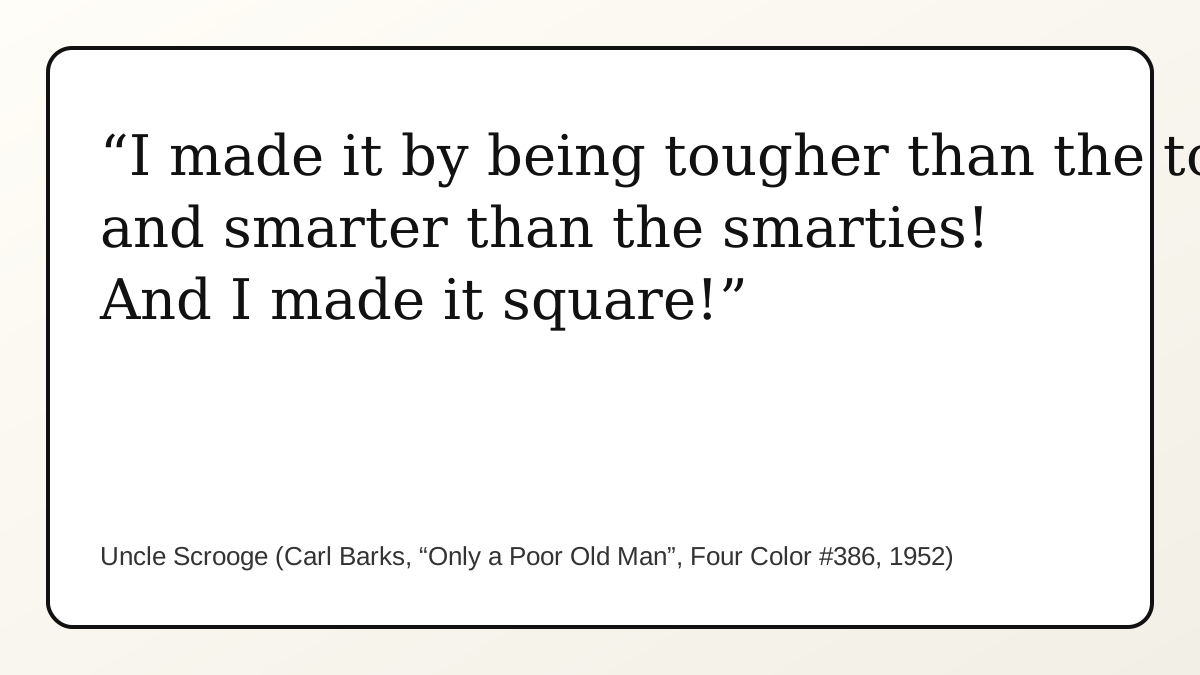
That’s the archetype. Tougher than the thugs, cleverer than the tricksters, deals sharply but cheats no one. A character sketch I came across recently is essentially Barks’s line rendered pretentiously, applied to the optimistic idea of the American. But underneath the Duckburg of it all, this is a description of the person who gets the work done, whatever the work is. The reason is that missions live in reality. A bridge holds or it doesn’t. A theorem is true or it isn’t. Reality is the thing that can’t be cheated, intimidated, or fooled, and the person whose working process runs through reality rather than through the social game around the work is the one who moves things forward. Every trait Barks packs into those three sentences is a trait of someone whose feedback loop is with the work itself: playing hard means engaging fully with the problem; playing clean means your results hold up to scrutiny; being tougher than the toughies means not being diverted by political pressure; being smarter than the smarties means not being fooled by plausible nonsense from credentialed people. Any institution that exists to accomplish something rather than merely to perpetuate itself needs exactly this person. And the interesting question is why, historically, institutions so reliably select against them.
The answer is a measurement problem. Evaluating whether someone actually advances the mission, whether the bridge holds, whether the theorem is true, whether the strategy worked, requires domain expertise, long time horizons, and tolerance for ambiguity. These are expensive. So institutions substitute proxies: credentials, publication counts, peer approval, social compliance, legibility to committees. And once the proxy becomes the selection target, the people who optimize for the proxy and the people who optimize for the work are no longer the same people. The navigator, the person who accumulates the right credentials, publishes in the right places, says the right things to the right people, looks optimal according to every metric the institution tracks. The person whose feedback loop runs through reality rather than through the proxy system looks, at best, like an uneven performer and, at worst, like a troublemaker. Worse still, navigators in positions of power select for more navigators, because navigators are what the system has taught them excellence looks like. The institution drifts. It is still selecting, still running its processes, still producing outputs that look like the mission, but it has lost contact with the thing itself.
Galileo, a generation before Spinoza, got house arrest for life.1 His middle finger is preserved in a museum in Florence, the relic of a man whose crime was insisting on what he could see through the telescope over what the authorities told him was there. Alice Dreger takes that image as the title of her book on modern scientific controversies. A central theme in the book is that evidence and intellectual freedom matter, and that liberal inquiry fails when arguments from personal authority are allowed to substitute for showing the work. Dreger herself embodies the tension. She started as an activist for intersex rights, found herself defending researchers she believed were being targeted by smear campaigns, and then became a target herself, eventually leaving Northwestern after being censored by her own dean. The person trying to deal sharply but cleanly in a system that keeps demanding you pick a side rather than follow the evidence.
This is the default outcome, and it is very old. Odysseus is maybe the earliest version of the archetype, tougher than the Cyclops, cleverer than Circe, deeply practical, unimpressed by anyone’s claims to authority including the gods’. Chandler’s Philip Marlowe is a modern one, moving between mansions and flophouses, corrupted by neither. You find the same figure in the medieval guild master, the good NCO, the self-taught engineer. What unites them is that they operate within systems of competition, play hard, and play clean. They are capable of trickery but choose not to deploy it, which is what separates them from the trickster proper, from Loki and Anansi. They’re closer to Prometheus, who stole fire not for personal advantage but because the work needed doing. And across every culture, the stories about this person have the same plot: the system expels them.2 The community has its learned men, and those learned men have their positions, and someone who respects the learning but not the learned is an intolerable threat to the arrangement.
The optimistic reading of America, not the country as it has actually been, but the idea that animated the experiment, is that it was an attempt to constitute a people around a written document from the very beginning. No king, no church, no inherited authority, just an agreement. Every previous community that tried this was probably destroyed by someone with an army before it could leave a record. This one survived long enough to become visible. That’s the novelty, or at least the luck. A place where the Spinozas wouldn’t need to be excommunicated because the social contract didn’t require submission to anyone’s claim of special authority over truth.
And here is what I think the description is really about. The work this person is trying to get on with is whatever the actual work is, the thing that needs doing and that the institutions supposedly exist to support. Sometimes that work is the pursuit of understanding. Sometimes it’s winning a war, or building something, or keeping people alive. The archetype is not limited to science, but science is where the pattern is clearest, because the whole point of scientific institutions is to advance knowledge, and the whole tragedy is how reliably they select against the person most likely to do it. Deals sharply but cheats no one, that’s honest inquiry, playing the game hard, competing for resources and attention, but never fabricating, never trimming the data, never letting the desire to win corrupt the desire to know. Tougher than the thugs, can withstand the institutional bullies, the gatekeepers, the people who maintain their position through intimidation rather than contribution. Cleverer than the tricksters, can see through the people gaming metrics, building careers on unfalsifiable claims, producing sophisticated-sounding work that dissolves on contact with reality. Says “I can do it” when others shrug, that’s the person who looks at an open problem everyone else has given up on and actually sits down to work.
And then the last piece, which is the sharpest: respects learning but is suspicious of those claiming to be learned. This is not anti-intellectualism. It is anti-credentialism, and the distinction matters enormously. This person’s epistemology is pragmatic. They respect knowledge because knowledge works, it predicts, it builds, it explains things that were previously mysterious. And they distrust credentials because credentials often don’t work, because they have seen too many people who can talk fluently about a thing and can’t do it, and too many people who can do a thing and can’t get a hearing. Tocqueville noticed this tendency in American democracy and Hofstadter later formalized it,3 but both were partly wrong about what they were seeing. They saw a rejection of expertise. What they were often looking at was a rejection of unverified claims to expertise, which is a completely rational response to a world full of people who have learned to perform knowledge rather than possess it.
In science, this becomes a vision for the activity itself, not science as an institution with its hierarchies and journals and tenure committees, but science as the relentless, competitive, honest pursuit of understanding. The person in this archetype doesn’t refuse to learn from anyone. They refuse to be intimidated by titles alone. Show me, they say. And if you can show them, they’ll respect you without reservation. The respect is real. It’s just not given on credit.
Spinoza, grinding lenses in his rented rooms to pay for the freedom to think, is what this looks like when the system fails. He does the work anyway, the Ethics is one of the most extraordinary intellectual achievements in history, but he does it as an outcast, because the community he came from had no mechanism for accommodating him. Galileo does the work under house arrest. Dreger’s modern scientists do it while fending off smear campaigns. The pattern is consistent enough to be a law: the person the system most needs is the person it most reliably expels.
We keep telling stories about this archetype, Odysseus, Marlowe, the stranger who rides into the corrupt town, and the frequency of the story is an index of how often we fail to build systems that select for them. When the systems work, this person is invisible, just a good scientist, a reliable soldier, a colleague doing their job. When they don’t, when the careerists win and the credential holders beat the competent and the thugs run the funding committees, we start telling the stories again.
These stories are not nostalgia or complaint. They’re a design specification. A reminder that the point was always the understanding, that the community was only ever supposed to be in service of the person trying to get on with the work, and that any arrangement which excommunicates that person has lost track of what it was for.
-
The sentence was formally imprisonment, commuted almost immediately to house arrest, first at the residence of the Archbishop of Siena and then, from December 1633, at his villa in Arcetri, outside Florence. He remained under house arrest until his death in 1642. He went completely blind in 1638. His final major work, Discourses and Mathematical Demonstrations Relating to Two New Sciences, was published in Leiden (Elsevier) in 1638. ↩
-
A partial inventory: Odysseus in the Greek epics, the man whose defining epithet is polytropos, “of many turns,” who survives not through rank or divine favour but through practical intelligence and endurance; who outwits the Cyclops, resists Circe, and talks back to the gods; and who is never forgiven by Poseidon for being the kind of person who solves problems rather than submitting to them. Socrates, who was given hemlock not for any specific heresy but for being the sort of person who asked questions that made credentialed men look foolish; the formal charges were “corrupting the youth” and “impiety,” but the real offence was that he could not be argued down and would not stop. Sundiata Keita in the West African tradition, a prince born crippled, exiled as a child because no one believed he would amount to anything, who returned to defeat the sorcerer-king Sumanguru Kante and founded the Mali Empire; the Sundiata epic makes the point explicitly: he prevailed not through inherited right but through demonstrated ability, and the people who had dismissed him were wrong in exactly the way credentialed gatekeepers are always wrong about the person who does the work rather than performing the role. Bao Zheng in the Chinese tradition, the incorruptible judge who could not be intimidated by rank and would not bend a case to please the powerful. Miyamoto Musashi in Japan, a ronin with no master and no school, who defeated every established swordsman he faced and then wrote the Book of Five Rings to explain why institutions of martial knowledge had lost track of what fighting actually was. Njáll in the Icelandic sagas, the wisest and most fair-dealing man in the community, who was burned alive in his house by men who couldn’t beat him any other way. The work changes. The pattern doesn’t. ↩
-
The relationship between this archetype and the intellectual tradition is more complex than simple opposition. Tocqueville, in Democracy in America (vol. II, 1840), was partly admiring: he compared Americans favorably to Descartes, noting that “each American appeals to the individual exercise of his own understanding alone” and that “the Americans do not read the works of Descartes … but they follow his maxims.” His concern wasn’t with the independence itself but with where it led: having rejected the authority of individuals and classes, democratic citizens tended to submit instead to the authority of the majority, trading one unfreedom for another. Hofstadter, in Anti-Intellectualism in American Life (1963), traced what he saw as a persistent hostility to intellectuals through American religion, politics, education, and business, and distinguished between practical intelligence and critical intellect. Neither thinker was simply diagnosing a pathology. The argument here is that both were partly seeing what the archetype describes, a rejection of unverified claims to authority, but that this was tangled up with genuine hostility to the critical function of intellect itself, and that disentangling the two is harder than either of them made it look. ↩